1. It is quite expensive.
2. It reaches a large audience.
3. It relies only on hearing.
4. It relies only on visual communication.
5. It may be skipped or deleted easily.
6. It allows for flexible response times.
7. It allows for the inclusion of documents or images.
8. There is a risk of miscommunication.
9. It allows for an immediate interaction between the two parties in the communication.
10. It expands your ability to communicate with distant people.
11. It limits the ability to interpret the context or emotion of the sender.
12. It allows for the use of non-verbal gestures, facial expressions, and personal charisma.
13. It is time consuming.
14. It allows for a personalised experience.
15. It doesn’t offer immediacy or speediness.
16. It isn’t available to everyone.
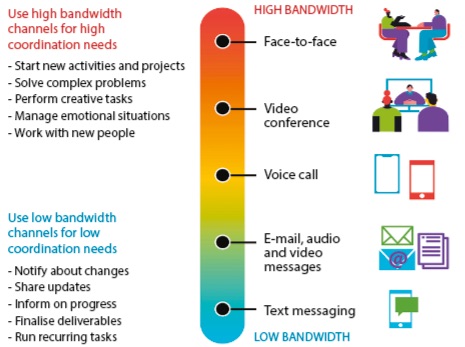
When at school, working on a new project for example, there could be different strategies. The teacher could give ideas and materials in class using high-bandwidth channels for high coordination needs. In a further step, the teacher could decide to use low-bandwidth channels like e-mails to ask for information about progress. An alternative could be the flipped classroom, where the teacher uses low-bandwidth channels at the beginning to launch the project, and then proceeds with group work in face-to-face contexts.