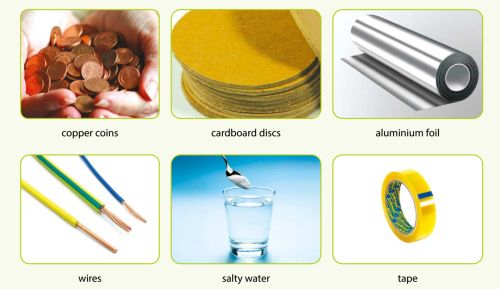
• Cut ten discs the same size of the coins from a sheet of cardboard.
• Put them into a container with salty water, so that they are completely immersed.
• Take a piece of foil and fold it at least four times; you should get a small square of foil a little larger than the coins.
• With the help of a coin, draw a disc on the foil and cut the foil around to get at least nine discs; as the foil has been folded many times, you will get enough of them.
• Place a coin on the table, put a wet cardboard disc on it and then one disc of foil; keep repeating the process until you have used all the coins.
• To use the battery, stick a wire on a piece of tape, then put the battery on it and fix another wire on top of the pile of coins with the help of another piece of tape, then wrap the tape all around the battery.
• Now, the battery is ready to be used to power very small devices; if the two wires are
connected, for example, to the two ends of an LED, it will be powered and emit light.
The following are the basic components of a home solar plant. Search for information about them and write a description of each component, explaining what its function is.
Solar panel Inverter Racking • Batteries aperta
• Inverter: a device which converts DC into AC so that the electricity produced can be used to power appliances in the house.
• Racking: the structure on which the solar system must be mounted.
• Batteries: they are needed to store the electricity produced by the solar system.
Here are a few tips for the correct maintenance of your three-phase electric motor. The frequency of your maintenance depends on factors such as:
motor age: older motors require more frequent maintenance;
motor usage: motors running 24/7 need more attention than those used less frequently.
Following a regular maintenance schedule will significantly extend your motor's life, improve its performance, and reduce maintenance costs.
We'll consider some of the most common problems.
Overheating is a major cause of motor failure. It damages winding insulation. To prevent overheating, use an infrared thermometer to check motor temperature during maintenance and consider installing temperature sensors for continuous monitoring.
Contamination: dirt, dust and moisture can interfere with motor cooling and damage it. Clean ventilation fans using a brush or compressed air protect the motor from moisture, keeping it dry, especially if it is not designed for wet environments.
Current and voltage: ensure voltage and current are suitable for the motor, as indicated by the producer, and avoid current spikes, which can cause damage to the motor components.
By following this maintenance checklist, you can significantly extend the life of your electric motor.
Adapted from: posted by
Overheating
Damages insulation
Use an infrared to check the temperature
Install temperature
Damages motor
Clean ventilation fans
Keep the motor
Current and
Current spikes may damage the motor
Ensure voltage and current are suitable for the motor
A 10-year-old motor feeding a dishwasher in a restaurant
A 1-year old motor feeding a pump in a factory working 24/7 aperta
Some tips: a 10-year-old motor feeding a dishwasher in a restaurant – the motor is quite old, so it needs more frequent maintenance. It is not used 24/7, but it undergoes some periods of intense activity, so, to avoid the dishwasher from stopping working when needed, it is necessary to be always sure that the motor works properly.
Moreover, pieces of food and moisture may damage it, so regular checks at least twice a year are advisable; 1-year old motor feeding a pump in a factory working 24/7: the motor is new, but it is always at work in a dirty environment, so dirt and dust can damage it. For this reason, it needs constant maintenance.